
Frank Lloyd Wright and a New Age of Iowa Architecture

Drake Hall and the transformation of Midwestern design at the turn of the twentieth century
At the turn of the twentieth century, architecture in the American Midwest was undergoing a remarkable transformation. Victorian traditions remained visible in the elaborate craftsmanship, stained glass, rich woodwork and decorative interiors of substantial homes. But a new generation of architects was beginning to challenge the conventions of the nineteenth century and search for a distinctly American architectural language.
At the center of that movement was Frank Lloyd Wright. Wright established his independent practice in Chicago in 1893 after working for the influential architect Louis Sullivan. During the years surrounding 1900, he began developing the ideas that would become synonymous with the Prairie School: strong horizontal lines, broad roofs, open interiors, geometric ornament and an intimate relationship between architecture and the surrounding landscape.
And Iowa was part of that story.

Wright's work eventually reached the state itself. His 1908 Stockman House in Mason City and 1910 City National Bank and Park Inn placed Iowa directly within the development of Prairie School architecture. Iowa preservation authorities also identify Wright, Sullivan, Walter Burley Griffin and William Drummond among the nationally and internationally important architects whose work helped bring Prairie School architecture to Iowa.
Drake Hall Was Built at a Fascinating Moment
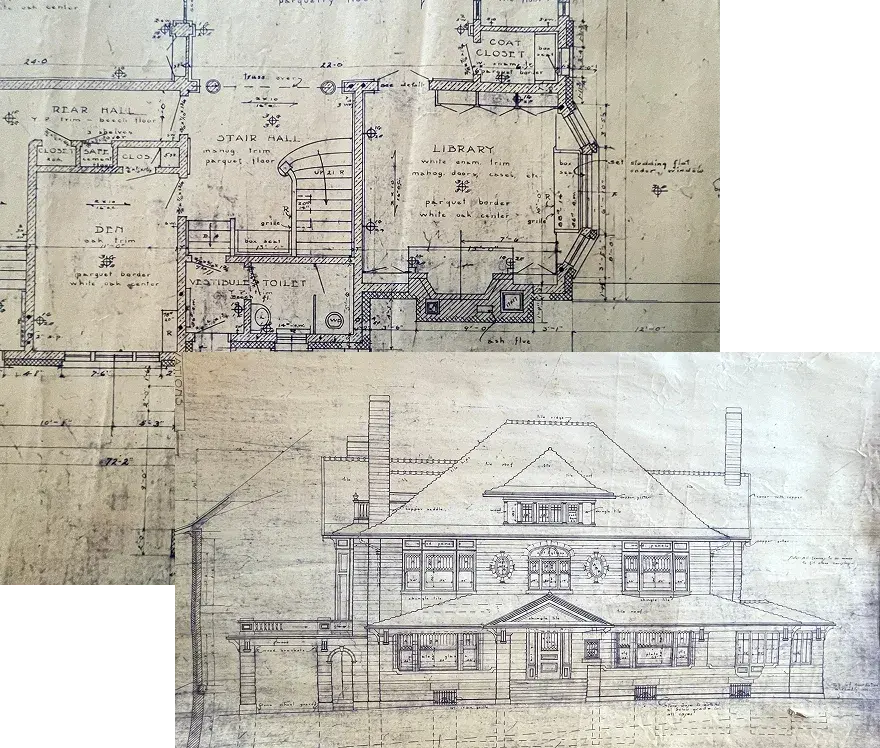
Drake Hall, built around 1900, emerged just as this architectural revolution was beginning.
It would be inaccurate to call Drake Hall a Frank Lloyd Wright house without evidence connecting Wright to its design. But placing the house within the architectural world in which Wright was working gives us important context. The turn of the century was not a moment when one architectural style abruptly replaced another. It was a period of experimentation. Victorian craftsmanship existed alongside Colonial Revival classicism. Arts & Crafts ideals elevated natural materials and hand craftsmanship. Soon, Prairie School architects would push Midwestern design toward simpler geometry, integration with the landscape and a new conception of interior space.
Drake Hall belongs to that transitional generation of Midwestern architecture.
Frank Lloyd Wright and the Art of the Interior
One of the most fascinating parallels is the importance placed on the interior itself.
For Wright and many designers of the period, architecture did not stop with the exterior walls. Windows, furniture, lighting, woodwork and decorative arts were conceived as parts of the architectural experience.
Art glass became particularly important to Wright's work.
His 1901 Ward Willits House incorporated art-glass windows as part of an integrated Prairie design, while the later Dana-Thomas House contains an extraordinary collection of approximately 250 art-glass windows and doors. That broader movement toward integrating architecture, craftsmanship and decorative art provides a fascinating context in which to experience Drake Hall today. Its stained glass is not merely decoration placed inside a house. The glass changes with daylight. Its landscape imagery draws the natural world into the interior. Dark wood surrounds brilliant fields of green, blue, amber and opalescent glass. The staircase, windows, lighting and woodwork combine to create an architectural experience rather than a collection of unrelated decorative elements. That idea was becoming increasingly important in American design at precisely this time.
Iowa Joins the Architectural Conversation
Wright was hardly alone. His former employer Louis Sullivan would create several extraordinary buildings in Iowa, including the Merchants' National Bank in Grinnell. Sullivan's Iowa buildings demonstrated how modern architecture could coexist with extraordinary ornament, terra cotta and colored glass.
Architects Walter Burley Griffin and William Drummond, both associated with Wright, also contributed to Iowa's Prairie School legacy. And Marion Mahony Griffin, one of America's pioneering women architects and a remarkable architectural artist, played an important role in developing and communicating the visual language associated with the movement.
Iowa, in other words, was not simply receiving architectural ideas developed somewhere else.
It became part of one of the most important periods in the history of American architecture.
Drake Hall: A House Between Two Centuries
That is perhaps the most compelling way to understand Drake Hall.
The house stands at a crossroads. Behind it was the richly ornamented architecture of the Victorian nineteenth century. Ahead lay Wright, Sullivan, the Prairie School, Arts & Crafts design and a radically different conception of what an American home could become. And within Drake Hall itself, the craftsmanship of that transitional era survives: stone, wood, patterned floors, architectural details and extraordinary stained glass that still transforms ordinary daylight into color.
More than a century later, Drake Hall allows us to experience the moment when Iowa architecture was stepping out of the Victorian age and into the modern American century.


Comments